Training
100 Pushups a Day: What Happens to Your Body, and Is It Worth It?
A hundred push-ups a day is one of the most popular challenges online, and it is easy to see why: no equipment, no gym, ten minutes. But doing it every day is not automatically better. Here is what to expect week by week, where it goes wrong, and a version most people can keep up for longer.
What happens when you do 100 push-ups a day
Week one: harder than it sounds
Unless you already train, a hundred will take many sets, and you will probably need to spread them across the day. Expect your chest, triceps and the front of your shoulders to be sore a day or two later. That is delayed-onset muscle soreness, and it is normal at the start.
Weeks two to four: it gets easier quickly
The soreness fades as your body adapts to the same work. Your sets get bigger and you need fewer of them. Much of this early improvement is your nervous system getting better at the movement, with more muscle fibres working together, rather than new muscle.
After a month: real but modest change
Your strength endurance will be noticeably better, and if you test your max set it will very likely be higher than on day one. How much your body looks different depends on where you started, what you eat, and whether a hundred was still a challenge at the end. For most people the change is modest.
After that: the plateau
Once a hundred is easy, doing a hundred again is not much of a stimulus. To keep improving, something has to get harder: more reps, less rest, a tougher variation, or a clock.
The benefits
- A lot of muscle for one movement. Push-ups work the chest, the front of the shoulders, the triceps and the serratus anterior along the ribs. Your core and glutes work throughout to hold the plank.
- A rough marker of fitness. A 2019 study of 1,104 male firefighters, followed for about ten years, found that those who could do more than 40 push-ups at the start had far fewer cardiovascular events than those who could do fewer than 10 (Yang et al., JAMA Network Open). It was an observational study of active middle-aged men, so it shows an association, not that push-ups prevent heart disease. Still, more push-ups tends to go with better fitness.
- An easy habit to remember. “A hundred a day” needs no plan. That is most of its appeal.
- Not much fat loss. A hundred push-ups uses some energy, but only a few minutes' worth. On its own it will not change your weight much; diet does most of that work.
The downsides of every single day
- Overuse. The same movement every day, with no full rest day, adds up on the wrists, elbows and the front of the shoulders. Aches that build over a few weeks are the usual way the challenge ends.
- All pushing, no pulling. Months of pressing with nothing to balance it can pull the shoulders forward. Rows or pull-ups fix that.
- Reps get sloppy. When the goal is a number, tired reps get shallower. A hundred half reps is not a hundred push-ups.
- All or nothing. Miss day twelve and the challenge counts as failed, which is exactly where many people quit. A daily streak punishes one bad day as hard as a bad month.
How to split 100 push-ups across the day
- 10 sets of 10, spread out. One set every hour or so. Frequent, comfortable sets are sometimes called “greasing the groove”. They build skill with very little fatigue.
- 4 sets of 25 around meals and breaks. Fewer interruptions, harder sets.
- All at once, timed. The hardest of the three, and the only one with a score you can beat. Most people end up with this version once a hundred stops being hard.
A better version: 100 for time, a few days a week
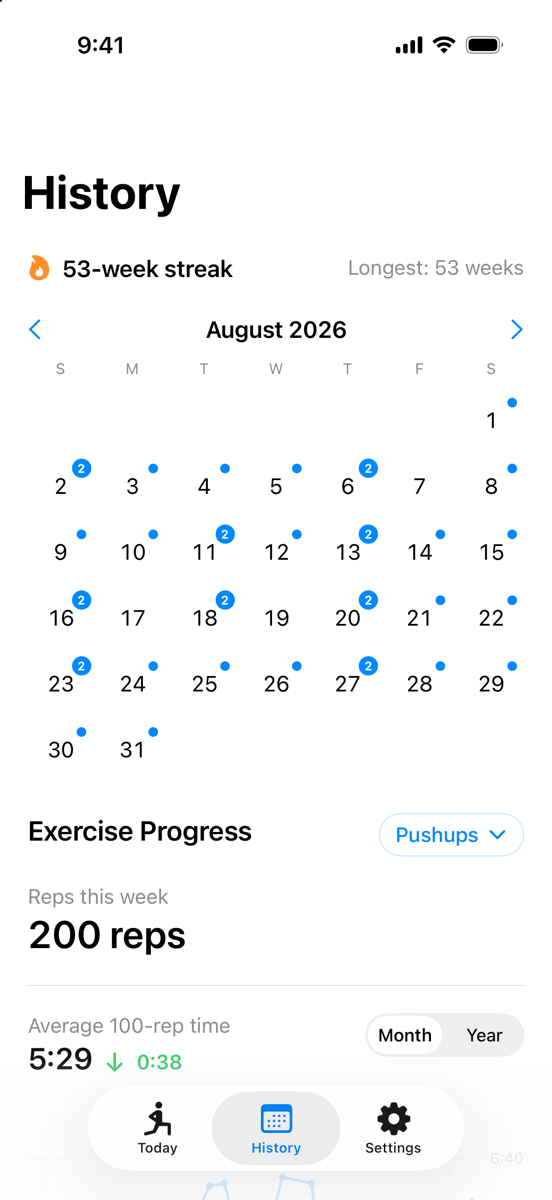
The daily challenge has the right idea: a fixed, simple target. Two changes make it easier to keep going:
- Do the hundred in one timed session, three or four times a week. The rest days let you recover, so each session is better quality. Because the score is a time, you can keep improving long after a hundred reps stops being hard. The 100 pushups challenge guide covers pacing.
- Count consistency in weeks, not days. One session in a calendar week keeps the week. A missed Tuesday costs nothing, so a bad week does not end the whole thing.
That is how Suta works. Each session is a timed hundred, a calendar marks every day you trained, and the streak counts weeks. Pushups are free, with no account to create.
Who should start somewhere else
- If you can't do a few full push-ups yet, start with the progression in push-ups for beginners and count incline push-ups towards your hundred.
- If you have a wrist, elbow or shoulder injury, a heart condition, or are pregnant, talk to a doctor or physiotherapist about how much and how often.
Questions and answers
Is 100 push-ups a day enough to build muscle?
In the first weeks, yes, especially if a hundred is hard for you. Once it gets easy, it mostly trains endurance. To keep building muscle, make the push-ups harder rather than adding more: raise your feet, lower slowly, or do the hundred faster.
Will 100 push-ups a day give me a bigger chest?
It can help, mostly early on and mostly if you eat enough protein and calories. Visible change after 30 days is usually modest. How much you notice depends on where you started.
How long does 100 push-ups a day take?
Between about 3 and 20 minutes of actual work, depending on your max set and how you split the reps. Spread through the day, it takes about a minute at a time.
Should I take rest days?
Rest days help most people. Three or four quality sessions a week usually beat seven tired ones, and they make overuse aches in the wrists and shoulders much less likely.
Can I do 100 push-ups a day if I can't do 10 in a row?
Yes. Split them into many small sets, or use incline push-ups with your hands on a counter or table. Keep the same variation for a few weeks so you can see progress.
What happens if I stop doing 100 push-ups a day?
You lose fitness gradually over weeks, not days, and it comes back faster than it took to build the first time. A week off will not undo a month of work.
Keep reading
- Challenge The 100 Pushups Challenge: Rules, Good Times, and How to Get Faster Three versions of the challenge, the rules that make a rep count, how long a hundred should take, and how to pace it.
- Beginners Push-Ups for Beginners: From Your First Rep to Your First 100 Form in five checks, a progression from the wall to the floor, a simple routine, and an honest answer to how long it takes.
- Tracking How to Track Push-Up Progress: What to Measure, and What to Ignore The five numbers worth logging, when to switch from reps to time, how to log push-ups, and how to read plateaus.