Challenge
The 100 Pushups Challenge: Rules, Good Times, and How to Get Faster
The 100 pushups challenge is about as simple as fitness gets: a hundred push-ups, as many sets as you need, and a clock. This guide covers the rules, what a good time looks like at your level, and how to pace the sets so the number keeps coming down.
What is the 100 pushups challenge?
People use the name for three different things:
- 100 for time. One session, any number of sets, with a clock running from the first rep to the last. Rests count. Your score is the total time. Most of this guide is about this version.
- 100 a day. A hundred push-ups every day for 30 days or longer, usually split across the day. It has its own trade-offs, covered in 100 pushups a day: what actually happens.
- 100 unbroken. A hundred in one set without stopping. A goal for years from now, not a place to start.
Of the three, 100 for time is the one most people can keep doing. Anyone can finish it: a beginner who takes twenty-five minutes still gets to a hundred. The score keeps improving for years after the hundred itself becomes easy. And it rewards strength (bigger sets) and conditioning (shorter rests) at the same time, so there is always something to improve.
The rules that make a rep count
Nobody judges this challenge, so you set the standard. Pick one and keep it, because a time only means something when you compare it with times done the same way.
- Straight line from head to heels. No sagging hips and no hips piked up in the air.
- Hands just wider than your shoulders, fingers forward, elbows about 45° from your body rather than flared out to the sides.
- Down until your chest is about a fist from the floor, or your elbows reach at least 90°.
- Up to straight arms at the top of every rep.
- The clock never stops. Rests are part of the time, and so is the walk to get water.
How long should 100 push-ups take?
There is no official standard, and nobody has properly studied 100-rep times, so treat any table you find online, including this one, as arithmetic rather than research. Two things decide your time: your max set (the most good reps you can do in one go) and how long you rest between sets.
The table assumes sets of about 60% of your max, a minute's rest between sets, and about a second and a half per rep:
| Your max set | Typical set | Sets needed | Rough time for 100 |
|---|---|---|---|
| 10 | 6 | 17 | 18–19 min |
| 20 | 12 | 9 | 10–11 min |
| 30 | 18 | 6 | 7–8 min |
| 50 | 30 | 4 | 5–6 min |
| 100 | 100 | 1 | 2–3 min |
Almost all of the time is rest. With a max of 20, the push-ups themselves take about two and a half minutes and the other eight are spent recovering. Two levers follow from that: raise your max set so you need fewer rests, and shorten the rests you do take. Moving faster during the reps hardly changes the total.
For milestones, under 10 minutes is a good first target. Under 5 means your max set is somewhere near 50, and that takes most people months of steady work.
Pacing: how to split the hundred
Most of the time you can save comes from not wrecking yourself on the first set.
- Start big, but stop short of failure. End your first set one or two reps before you would have to stop. A first set taken to failure makes every set after it smaller and every rest longer.
- Let the sets shrink. Someone with a max of 25 might go 18, 15, 13, 12, 10, 10, 10, 8, 4. Sets that get smaller as you tire are normal and work well.
- Keep rests short and even. Thirty to sixty seconds is plenty for most sets. Most of the lost time goes on rests that stretch to two minutes while you look at your phone.
- Break the last twenty into small pieces. Near the end, quick sets of three to five with ten-second rests beat one long rest followed by a set you can barely finish.
How to get faster, week after week
- Run it two to four times a week, not every day at full effort. Muscles adapt between sessions, not during them.
- Change one thing at a time. One more rep in the first set, or five seconds less on each rest. Small changes add up over a month.
- Build your max set on other days. A few hard sets of a tougher variation, such as feet raised on a step or a slow three-second lowering, build strength that carries over to your hundred.
- Balance it with pulling. Rows or pull-ups keep your shoulders from rounding forward under all that pushing.
- Expect flat weeks. Single sessions vary with sleep, food and mood. Watch your average across a month rather than any one day.
Staying healthy
- Wrists: if they complain, use push-up handles or dumbbells, do push-ups on your fists, or put your hands on a low step to change the angle.
- Shoulders: keep your elbows at about 45° from your body. Elbows flared out to the sides are hard on the front of the shoulder over hundreds of reps.
- Soreness in your chest and arms for a day or two after your first few sessions is normal. Sharp pain in a joint is not. Stop and rest it.
- If you have a heart condition, high blood pressure or a recent injury, check with a doctor before going all out against the clock.
Tracking your time
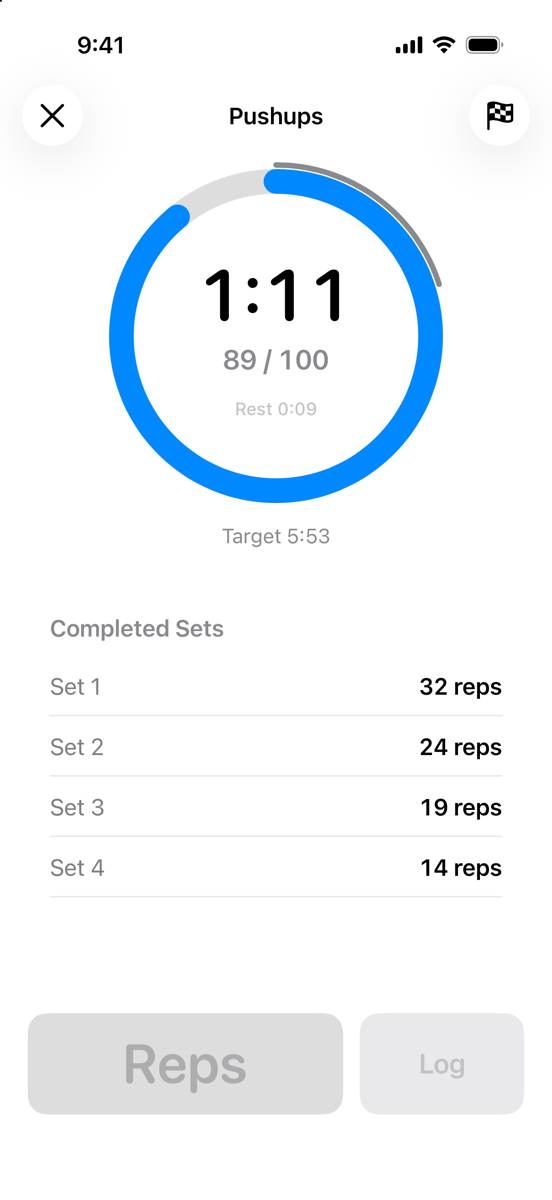
A timed hundred needs two things: a clock that keeps running through rests, and a record of each set so you can see how you paced it. A stopwatch and a notes app will do the job.
We built Suta for this challenge. You start the clock, log each set as you finish it, and the session ends itself at 100. Your fastest hundred is drawn as a second arc on the ring, so you can see mid-session whether you are ahead of your best. A rest readout counts up from your last set. Afterwards you see every set end to end, and whether you set a new record. The pushups challenge is free.
Questions and answers
Is doing 100 push-ups in one session good for you?
For most healthy adults who build up to it, yes. It works the chest, shoulders, triceps and core, and builds strength endurance. Start with whatever variation lets you finish, take as many sets as you need, and stop if a joint hurts rather than just feeling tired.
How many sets should I use for 100 push-ups?
As many as it takes. With a max set of 20, expect about nine sets. With a max of 50, about four. The sets shrink as you tire. Stop each one a rep or two before failure and you will need fewer of them overall.
What is a good time for 100 push-ups?
There is no official standard. Under 10 minutes is a solid first milestone and usually means a max set of about 20. Under 5 minutes takes a max set near 50. Your own previous best is the time that matters.
Can a beginner do the 100 pushups challenge?
Yes. Take as many sets as you need, or use an easier variation such as incline push-ups with your hands on a counter, and keep the variation the same from session to session so your times compare. The push-ups for beginners guide covers the steps in between.
How often should I do the challenge?
Two to four times a week works well. Your muscles recover between sessions, so each one is better quality than if you went all out every day.
Does the 100 pushups challenge build muscle?
Some, especially in the first months. Once a hundred becomes easy, it mostly trains endurance. For more muscle growth, add harder variations that you can only do 5 to 15 times, such as feet-elevated or slow-lowering push-ups.
Keep reading
- Training 100 Pushups a Day: What Happens to Your Body, and Is It Worth It? What changes in week one, after a month and beyond, what can go wrong, and a version you can keep up for longer.
- Beginners Push-Ups for Beginners: From Your First Rep to Your First 100 Form in five checks, a progression from the wall to the floor, a simple routine, and an honest answer to how long it takes.
- Tracking How to Track Push-Up Progress: What to Measure, and What to Ignore The five numbers worth logging, when to switch from reps to time, how to log push-ups, and how to read plateaus.