Tracking
How to Track Push-Up Progress: What to Measure, and What to Ignore
Push-up progress is slow enough to doubt and fast enough to miss. A simple record fixes both problems, as long as you record the right numbers. Here is what to measure at each stage, how to log it, and how to tell a plateau from a bad day.
Why track push-ups at all?
Training on your own has one weakness: nobody notices when you improve, and nobody notices when you stop. A record covers both. It shows the slow change you can't feel from one session to the next, and it makes a gap visible before it turns into a month off.
The five numbers worth tracking
| Number | What it tells you | When it matters |
|---|---|---|
| Max set | Raw strength endurance: the most good reps in one go | Always. Test it every few weeks, fresh |
| Reps per session | How much work you did | While you are working up to 100 |
| Time to 100 | Strength and conditioning in one number | Once 100 in a session is routine |
| Sets to 100 | How well you paced it | Alongside time, for spotting why a session was slow |
| Sessions per week | Consistency, which drives everything above | Always |
What to ignore: calories burned (small and badly estimated), lifetime total reps (it only ever goes up, so it can't tell you whether you're improving), and other people's numbers.
Track reps first, then time
While a hundred in one session is still out of reach, the number that moves is how many reps you managed. Chart that. Once you finish a hundred every time, the rep count is stuck at 100 and stops telling you anything. Switch to time: how long the whole hundred took, rests included. Time keeps improving for years, because a stronger you needs fewer sets and shorter rests. The 100 pushups challenge guide covers how to bring it down.
Four ways to log push-ups
- A paper notebook. Date, variation, each set, total time. Free, and it works. The downside is that you have to draw your own charts.
- A spreadsheet or notes app. Easy to chart, but tedious to fill in between sets, which is when it matters.
- A rep-counter app. These use the camera or a sensor to count reps as you do them. They're useful if counting is the hard part. Counting and tracking are different jobs, though, so check what the app keeps afterwards.
- A push-up tracker. You enter each set, and the app keeps the clock, the history and the records. Pick one that shows trends over months, not just today.
Daily streaks vs weekly streaks
Streaks work because you don't want to break them. Daily streaks also have a known failure: one missed day sends the number back to zero, the number was the reason you kept going, and so you stop.
A weekly streak keeps the motivation without that cliff. One session in a calendar week keeps the week. You can clear that bar in a terrible week, and clearing it in terrible weeks is the difference between training a year from now and not.
Reading your numbers
- Look at monthly averages, not single sessions. Sleep, food, stress and the time of day all move a single session. A month smooths that out.
- A bad day is one session; a plateau is three or four weeks. If your average has not moved in a month, change something: shorter rests, a harder variation on another day, or a lighter week to recover.
- Retest your max set fresh, at the start of a session, every three or four weeks. It is the best way to see if strength is still going up.
- Compare like with like. Same variation, same standard of rep. A faster time on shallower reps is not progress.
How Suta tracks it
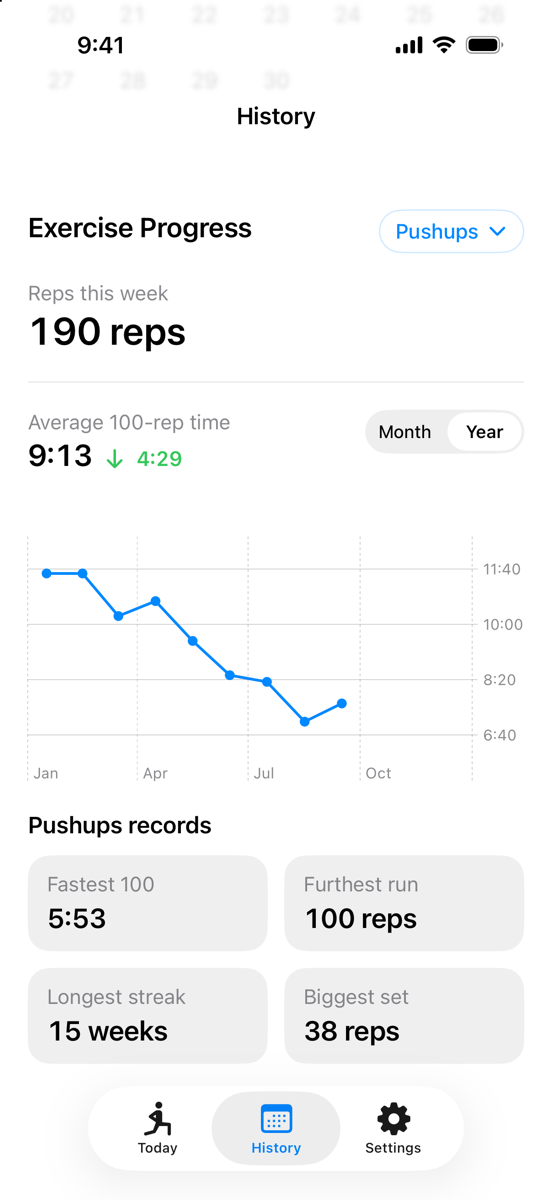
Suta is a push-up tracker built around the numbers above. Each session is a timed hundred: you log each set as you finish it, and it stops at 100. Suta doesn't count reps with the camera. You enter them.
- A calendar with a dot on every day you trained, back to your first session.
- A progress chart that shows reps while you are working up to a hundred, and time once a hundred is routine.
- Four records: fastest 100, furthest run, longest streak and biggest set.
- A streak counted in weeks.
All of that is free for pushups, with no account. Sessions sync through your own iCloud.
Questions and answers
What is the best way to track push-ups?
Write down the date, the variation, every set and the total time for each session, then look at the trend once a month. A notebook works, and a dedicated push-up tracker saves you drawing the charts yourself.
What should I track to see push-up progress?
Your max set, your reps per session while you're working up to a hundred, your time for 100 once you can finish it, and how many sessions you do each week.
How often should I test my max push-ups?
Every three to four weeks, at the start of a session when you are fresh. Testing more often mostly measures how tired you are.
Do I need to log every set?
It helps. Your sets show how you paced the session, which explains why one time was slower than another. A tracker you can update between sets makes this easy.
Why has my push-up progress stalled?
Usually because the sessions have stopped getting harder. Shorten your rests, add a harder variation on another day, or take a lighter week to recover. Then retest your max.
Keep reading
- Challenge The 100 Pushups Challenge: Rules, Good Times, and How to Get Faster Three versions of the challenge, the rules that make a rep count, how long a hundred should take, and how to pace it.
- Beginners Push-Ups for Beginners: From Your First Rep to Your First 100 Form in five checks, a progression from the wall to the floor, a simple routine, and an honest answer to how long it takes.
- Training 100 Pushups a Day: What Happens to Your Body, and Is It Worth It? What changes in week one, after a month and beyond, what can go wrong, and a version you can keep up for longer.