Beginners
Push-Ups for Beginners: From Your First Rep to Your First 100
If you can't do a push-up yet, or can only do a few, you are starting where almost everyone starts. You don't need a 10-week plan. You need the right version of the exercise for today, and a way to tell when you're ready for the next one.
Good push-up form, in five checks
- Hands under your shoulders, or a little wider, fingers pointing forward.
- Body in one straight line from head to heels. Squeeze your glutes and brace your stomach as if someone were about to poke it.
- Elbows at about 45° from your body, an arrow shape rather than a T.
- Lower until your chest is about a fist from the floor, or your elbows are at least at 90°.
- Push back up to straight arms, breathing out as you push.
Every variation below uses the same five checks. Only the angle changes.
Find your starting point
Do as many full push-ups as you can with good form and stop when your form breaks. That number is your max set. If it is zero, try the same test with your hands on a kitchen counter. Write down the number, the variation and the date. It is the baseline you will compare everything against, and it is usually more encouraging to look back on than you expect.
The push-up progression
Each step is the same movement at a harder angle. Move on when you reach the target in the right-hand column with good form.
| Step | Variation | Move on at |
|---|---|---|
| 1 | Wall push-up, standing an arm's length away | 3 sets of 20 |
| 2 | High incline, hands on a kitchen counter | 3 sets of 15 |
| 3 | Low incline, hands on a sturdy table, bench or stair | 3 sets of 12 |
| 4 | Knee push-up, body straight from knees to head | 3 sets of 12 |
| 5 | Negatives: a full push-up position, lowering slowly for 3–5 seconds | 3 sets of 5 |
| 6 | Full push-up | Your first clean rep |
Inclines and knee push-ups both work. Inclines keep the full plank position, so they lead more directly to the real thing. If your knees don't like the floor, skip step 4 and use a lower and lower step instead.
A simple routine: three days a week
- Three sessions a week on days that aren't back to back, for example Monday, Wednesday and Friday.
- Three to five sets of your current step. End each set one or two reps before you would have to stop.
- Rest 60 to 90 seconds between sets.
- Move up a step when you hit the target. If the new step is too hard, mix them: a set of the new one, then the rest at the old one.
- Once you can do about ten full push-ups, try the 100 pushups challenge. Take as many sets as you need and time it. It becomes your new baseline.
Common beginner mistakes
- Sagging hips. Your lower back takes the load instead of your arms and chest. Squeeze your glutes.
- Elbows flared straight out. Hard on the shoulders. Tuck them to about 45°.
- Half reps. Going halfway down feels like progress but builds less strength. Use an easier variation and go all the way down.
- Leading with the head. Your nose reaches the floor before your chest. Look at the floor just ahead of your hands and keep your neck in line.
- Holding your breath. Breathe in on the way down and out on the way up.
- Doing too much in week one. A hundred sloppy reps on day one usually means a sore week and a quiet month. Start smaller than your enthusiasm suggests.
How long until you can do 100 push-ups?
It depends on what “do 100” means:
- 100 in one session, any number of sets: sooner than you'd think. With ten full push-ups or a solid incline, you can finish a hundred today. It might take twenty minutes and a lot of small sets, and that is fine.
- Your first full push-up: anywhere from a couple of weeks to a few months from zero, depending on your strength, body weight and how consistently you train.
- 100 unbroken: a long-term goal. For most people it takes many months of steady training, and some never need to get there to be strong and fit.
Keep track, because progress is easy to miss
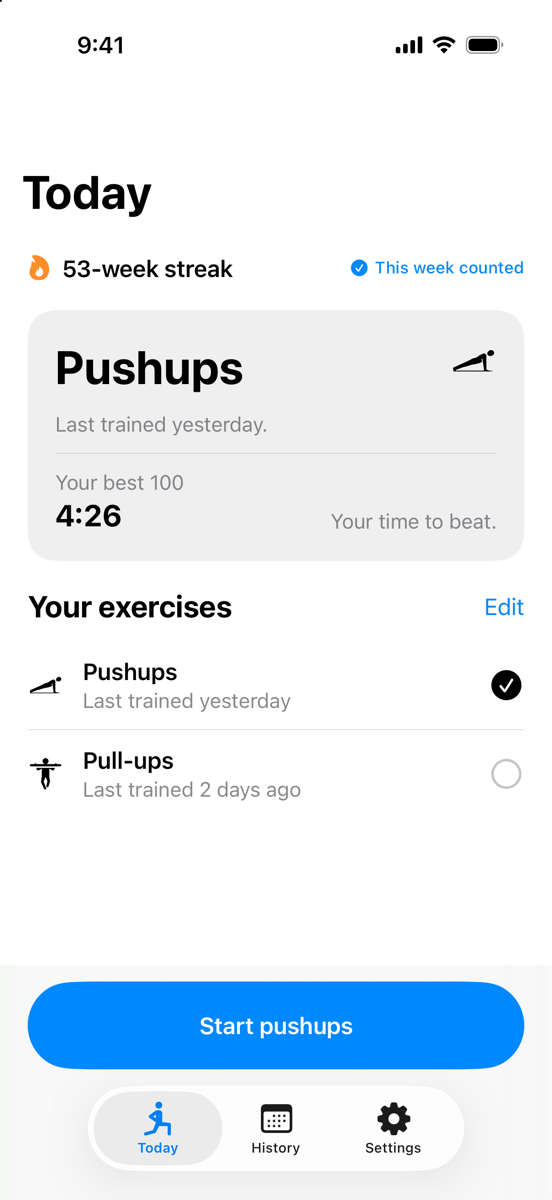
Early progress comes fast, but each change is small enough to miss. Without a record it can feel like nothing is happening. Write down your sets, or use an app.
Suta is built around the hundred. Log each set as you go and it keeps the clock, your history and your records. While you're still working up to a hundred it charts your reps, and once a hundred is routine it charts your time. There's no plan to follow and no account to create. Pushups are free.
Questions and answers
Why can't I do a single push-up?
A full push-up lifts a large share of your body weight, so it takes more strength than it looks. Almost everyone builds up to it. Start with wall or incline push-ups and lower the angle over a few weeks.
Do knee push-ups count?
They are a real exercise and a good step towards full push-ups. Keep your body straight from knees to head. If you are timing a hundred, use the same variation each session so your times compare.
How many push-ups should a beginner do a day?
You don't need to do them every day. Three to five sets of your current variation, three times a week, is plenty to improve. Stop each set a rep or two before your form breaks.
Is it normal for my arms to shake?
Yes. Shaking near the end of a set is your muscles working close to their limit. If your form breaks, end the set there.
Are push-ups good for women and older beginners?
Yes. The progression is the same for everyone, and starting at the wall or a counter makes it suitable at almost any age or fitness level. If you have a joint problem or a heart condition, check with a doctor first.
Should I do the 100 pushups challenge as a beginner?
Once you can manage about ten full push-ups, or plenty of incline ones, yes. Take as many sets as you need and use the time as your baseline. It is a good way to see progress week to week.
Keep reading
- Challenge The 100 Pushups Challenge: Rules, Good Times, and How to Get Faster Three versions of the challenge, the rules that make a rep count, how long a hundred should take, and how to pace it.
- Training 100 Pushups a Day: What Happens to Your Body, and Is It Worth It? What changes in week one, after a month and beyond, what can go wrong, and a version you can keep up for longer.
- Tracking How to Track Push-Up Progress: What to Measure, and What to Ignore The five numbers worth logging, when to switch from reps to time, how to log push-ups, and how to read plateaus.